
James Jeong · Health Content Researcher
How to Change Your Supplement Timing: The Complete Guide to a Less Tiring Routine
Table of Contents
- What to Know Before You Start: Why Changing Only Your Supplement Timing Can Feel Different
- Step 1. Why Should You Split Up Your Supplements? The Link Between Fatigue and Absorption Efficiency
- Step 2. How to Set Your Supplement Schedule: A Simple Morning, Afternoon, and Evening Plan
- Step 3. Change It Today: A Supplement Routine You Can Apply Right Away
- Step 4. What to Check If You’re Still Tired: Signs to Look at Before Adding More Supplements
What to Know Before You Start: Why Changing Only Your Supplement Timing Can Feel Different
Why do you still feel tired even when you take several supplements every day? With supplements, what you take matters, but so does when and how you space them out.
Taking everything at once is convenient, but each nutrient has different conditions for best absorption. Some are better absorbed with a meal that includes fat, while others may become less effective if taken with coffee or calcium.
Recent medical and public health sources point to a fairly clear list of nutrients to check first when fatigue is involved. Iron, vitamin B12, vitamin D, and magnesium are all linked to energy metabolism, oxygen transport, and nerve and muscle function, so if you’re low in them or taking them at the wrong time, everyday fatigue can feel much worse.
- Vitamin D, omega-3: More practical to take with food rather than on an empty stomach
- Iron: Important to leave space between it and coffee, tea, milk, or calcium
- Vitamin B12: A water-soluble supplement that fits easily into a morning routine
- Magnesium: Can be moved to after meals or the evening if your stomach is sensitive
What matters here is that changing supplement timing is not a magic fix for everything. If fatigue is getting worse or lasting a long time, it’s better to look at your recent sleep, meals, exercise, menstrual cycle, stress, and any medications you’re taking instead of simply adding more supplements.
To put it simply in a bodymemo style: separate nutrients with different absorption conditions, and lock them into a schedule that’s easy to repeat every day. That’s the first step.
Step 1. Why Should You Split Up Your Supplements? The Link Between Fatigue and Absorption Efficiency
The biggest reason to split up supplements is that some combinations interfere with each other’s absorption. A classic example is iron and calcium.
Iron is essential for carrying oxygen through the body, so when levels are low, you may feel tired easily, get short of breath, or notice poorer concentration. But if you take iron at the same time as calcium, milk, coffee, or tea, absorption may drop, which means you might not feel the benefits as much as expected even if you’re taking it diligently.
On the other hand, nutrients that are absorbed along with fat, such as vitamin D, vitamins A, E, and K, and omega-3, are more realistically taken right after a meal than on an empty stomach. If your breakfast or lunch includes a little fat from foods like eggs, nuts, milk, yogurt, or avocado, that’s a good time to take them.
- Iron + calcium: Don’t take them together
- Iron + coffee/tea: Leave at least 1 to 2 hours between them
- Vitamin D + omega-3: Place them after a meal
- Calcium: Better divided into doses of 500 mg or less rather than taking a large amount at once
Magnesium is a little different. It supports energy production and muscle function, but for some people it can cause stomach discomfort or loose stools. That’s why moving it to the time your body feels most comfortable and taking it consistently is often the most helpful strategy in real life.
In the end, a supplement routine for reducing fatigue works better when you group together nutrients that work well side by side and separate the ones that interfere with each other, instead of just taking everything that seems helpful all at once. That difference can affect how you feel more than you might expect.

Step 2. How to Set Your Supplement Schedule: A Simple Morning, Afternoon, and Evening Plan
If this feels complicated, it’s enough to divide your day into just three slots: after breakfast, midday/afternoon, and evening. The key is making it fit your routine so you don’t forget.
The first time slot I recommend is right after breakfast. Vitamin D, omega-3, multivitamins, and B vitamins or B12 are easy to remember at that time, and fat-soluble nutrients are also easier to take with food.
Iron is better handled separately. If you always drink coffee in the morning, move iron to around lunch or later in the afternoon, and make sure it doesn’t overlap with dairy products or calcium supplements.
- After breakfast: Vitamin D, omega-3, multivitamin, vitamin B12
- Lunch/afternoon: Take iron alone if you need it
- After dinner or before bed: Adjust magnesium based on your individual response
- Calcium: Take it separately from iron and place it with a meal
Calcium also varies a little depending on the form. Calcium carbonate is best taken with food, while calcium citrate can be taken with or without food, so it’s worth checking the product label once.
If you’re taking thyroid medication, you need to be more careful. In general, it’s safer to leave a generous gap between thyroid medication and calcium, iron, or magnesium, so if that applies to you, adjust your schedule separately based on your doctor’s or pharmacist’s guidance.
The goal at this stage is not a perfect schedule. What matters most is building one schedule that fits your daily life and is easy to keep.
Step 3. Change It Today: A Supplement Routine You Can Apply Right Away
From here, don’t overthink it. Just start moving the supplements you’re already taking today, one by one. Instead of changing everything at once, it feels much more manageable to organize the nutrients most closely tied to fatigue first.
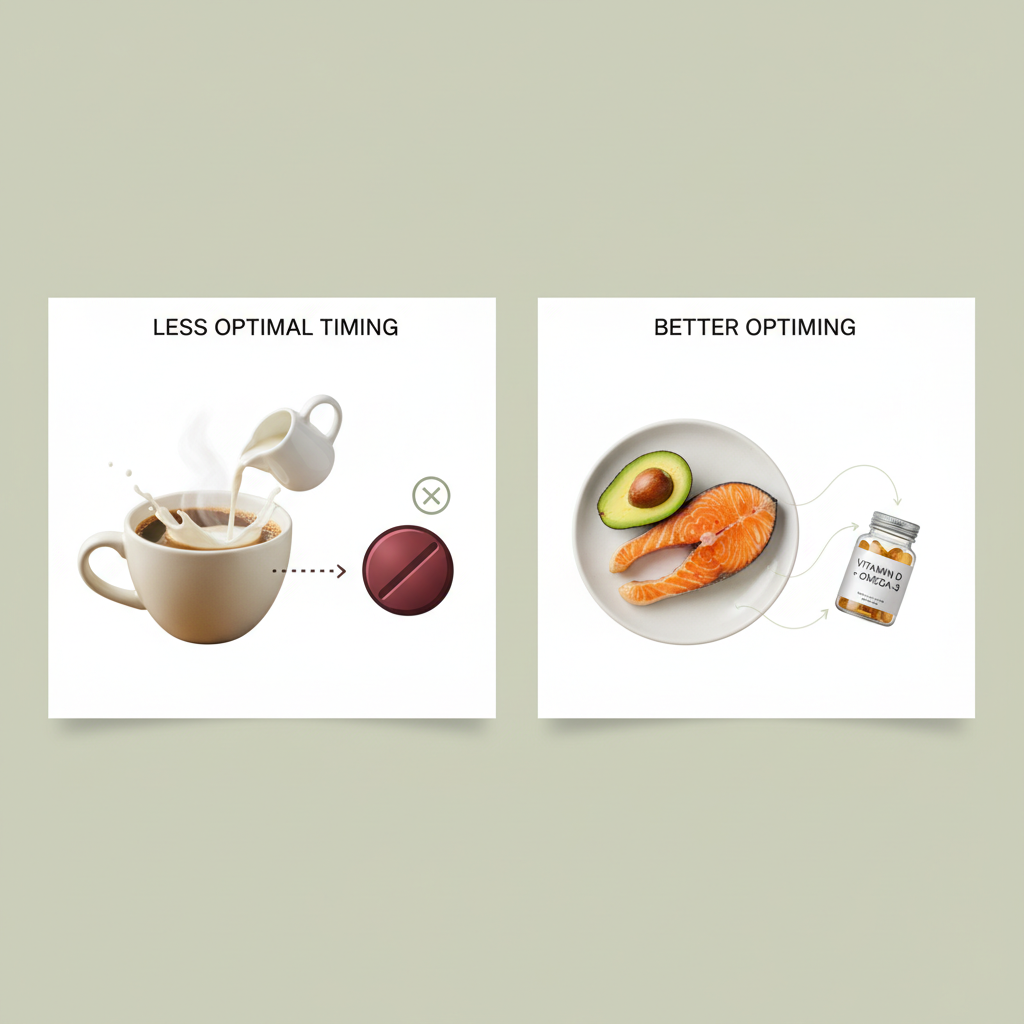
The easiest first adjustment is vitamin D and omega-3. If you’ve been taking them on an empty stomach, try moving them to after a meal that contains some fat.
The second is iron. If you’ve been taking iron while drinking your morning coffee, or swallowing it together with a multivitamin and calcium supplement, that’s the first thing to separate. This can make an even bigger difference if you tend to be anemic or often feel tired because of heavier periods.
- Morning supplements: Move vitamin D and omega-3 to after a meal
- Iron supplement: Take it around lunch or in the afternoon, away from coffee
- Evening magnesium: Move it to after dinner if your stomach is sensitive
- Calcium: Separate it into a different time slot from iron
If you take vitamin B12, it can also work well as part of your morning routine. Some people feel a bit sharper when they take it earlier in the day, which makes morning use feel more practical.
If you feel especially drained after exercise, think about your recovery routine separately from your regular supplement schedule. Recent meta-analyses suggest that taking protein and carbohydrates together right after exercise can meaningfully help with recovery and fatigue reduction.
What matters is not “more,” but “better matched.” Changing your supplement timing may seem like a small tweak, but because you repeat it every day, the cumulative difference can feel surprisingly big.

Step 4. What to Check If You’re Still Tired: Signs to Look at Before Adding More Supplements
If you’ve adjusted your supplement timing well and still feel tired, it’s time to check for an actual deficiency or another underlying cause, rather than assuming the problem is your routine. This is especially true if the fatigue lasts for several weeks or comes with dizziness, heart palpitations, or repeated trouble concentrating.
The first things to check are fairly clear. Iron, vitamin D, and vitamin B12 are among the most common fatigue-related markers, so confirming them through testing is much more efficient.
- Signs that may suggest low iron: Getting out of breath easily, looking pale, headaches, poor concentration
- Signs that may suggest low vitamin D: Low energy, reduced activity, muscle discomfort
- Signs that may suggest low vitamin B12: Fatigue, dizziness, a racing-heart feeling
- Magnesium-related check points: Muscle tightness, eyelid twitching, poorer sleep quality
Another thing to review is dosage and product composition. Just because you’re taking a multivitamin doesn’t mean you’re getting enough of what you actually need, and on the other hand, many people end up taking overlapping products unnecessarily.
Lifestyle matters too. If you’re sleeping too little, skipping meals often, consuming a lot of caffeine, or eating too little because of dieting, supplement timing alone may not solve your fatigue.
To leave one last note in a bodymemo style: before adding more supplements because you feel tired, first organize your current supplement schedule and check the key nutrient levels linked to fatigue through testing. That’s the most realistic order.
The routine worth saving isn’t complicated. Split them up at times that work for you, and if you still feel tired, check the cause. Those are the only two things you really need to remember.
Frequently Asked Questions (FAQ)
Q. Do supplements have to be taken in the morning?
A. Not necessarily. What matters more than the exact hour is understanding each nutrient’s absorption conditions and building a schedule you can stick to consistently.
Q. How far apart should I space iron and coffee?
A. In most cases, leaving at least 1 to 2 hours between them is a practical approach. It’s also best to avoid taking iron at the same time as tea, milk, or calcium supplements.
Q. Can I take vitamin D and omega-3 on an empty stomach?
A. You can, but absorption tends to be better when you take them with a meal, especially one that includes a little fat. Keeping them as part of your morning post-meal routine can also help build consistency.
Q. Is magnesium always better at night?
A. Not always. The most important thing is choosing a time that feels comfortable on your stomach and is easy to keep up with. If it irritates your stomach, moving it to after dinner or the evening can be a realistic strategy.
Q. What should I do if I still feel tired even after changing my supplement timing?
A. It’s a good idea to check fatigue-related markers such as iron, vitamin D, and vitamin B12 through testing. If the fatigue is severe or lasts a long time, it’s safer to speak with a medical professional instead of trying to solve it with supplements alone.
Tags: #supplements, #supplement timing, #fatigue management, #vitamin D, #iron
Author
James Jeong
Health Content Researcher
Summarizes practical health, nutrition, and habit guidance using public sources and evidence-led routines.